The LJR Curriculum:
Our LJR Curriculum Is the path to bright future in dance!
If your dancer is serious about pursuing a career in the dance industry, our advanced stream of classes is designed just for them. The curriculum is for dedicated dancers and families who are committed to Troupe Competitions, Examinations, Concerts, and a potential future in the dance world. We take pride in developing well-rounded dancers with exceptional technical skills and performance quality across various genres, giving them the best chance at a successful career. In the curriculum, your dancer will be surrounded by like-minded, driven, and hardworking individuals, all striving for excellence. It’s the perfect environment for those who want to push their limits. Students must be enrolled in the LJR Curriculum to be eligible to have a private lesson for competitive solos. Before enrolling in the LJR Curriculum, please carefully read through our Troupe Handbook (found on the ‘Handbooks’ page) to ensure you can fully commit to the requirements of being in Troupe.
Students must enrol in and attend the full curriculum. However, exemptions may be granted to senior students looking to specialise, or in certain circumstances . To apply for an exemption, please email ljrdanceacademy@gmail.com.
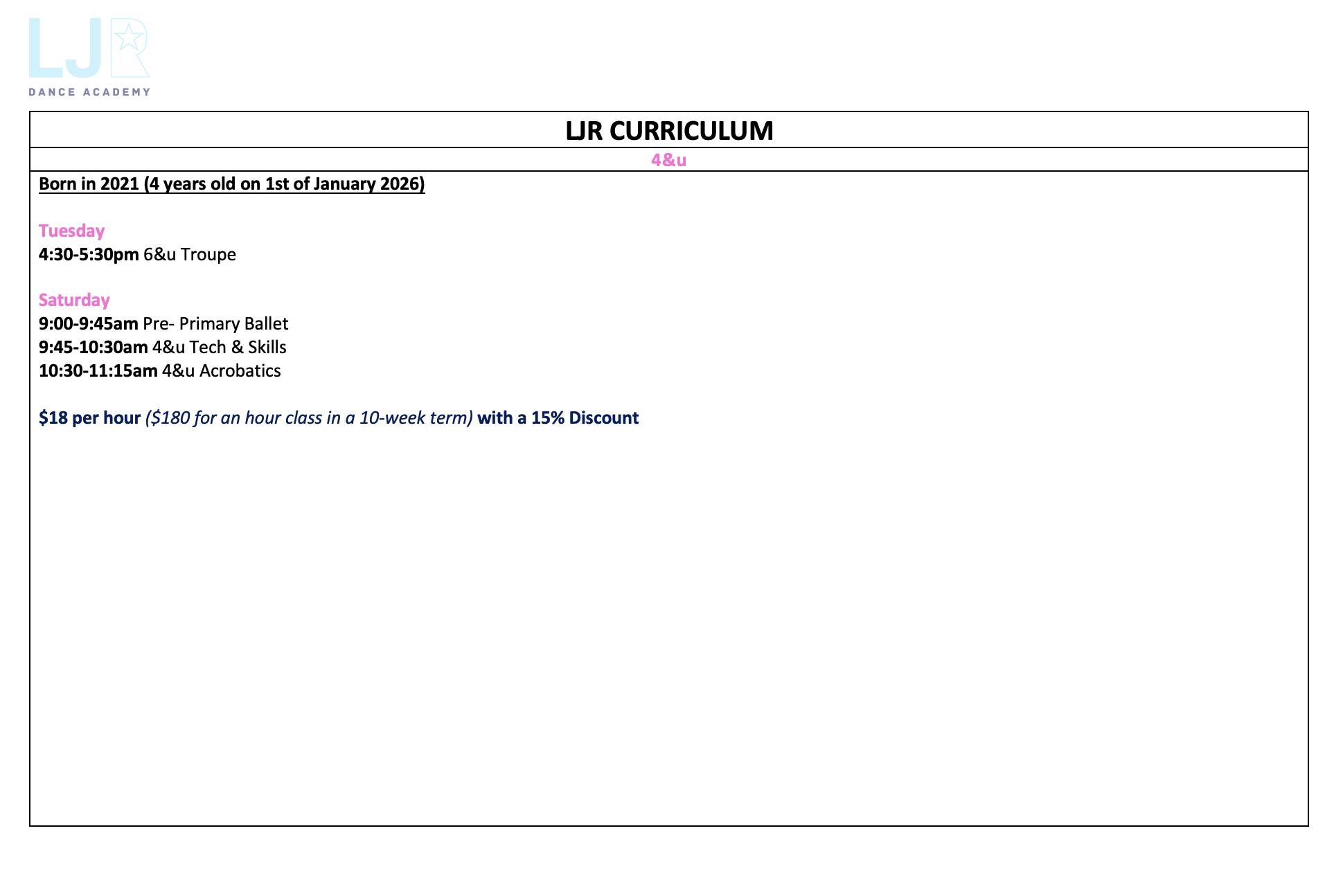
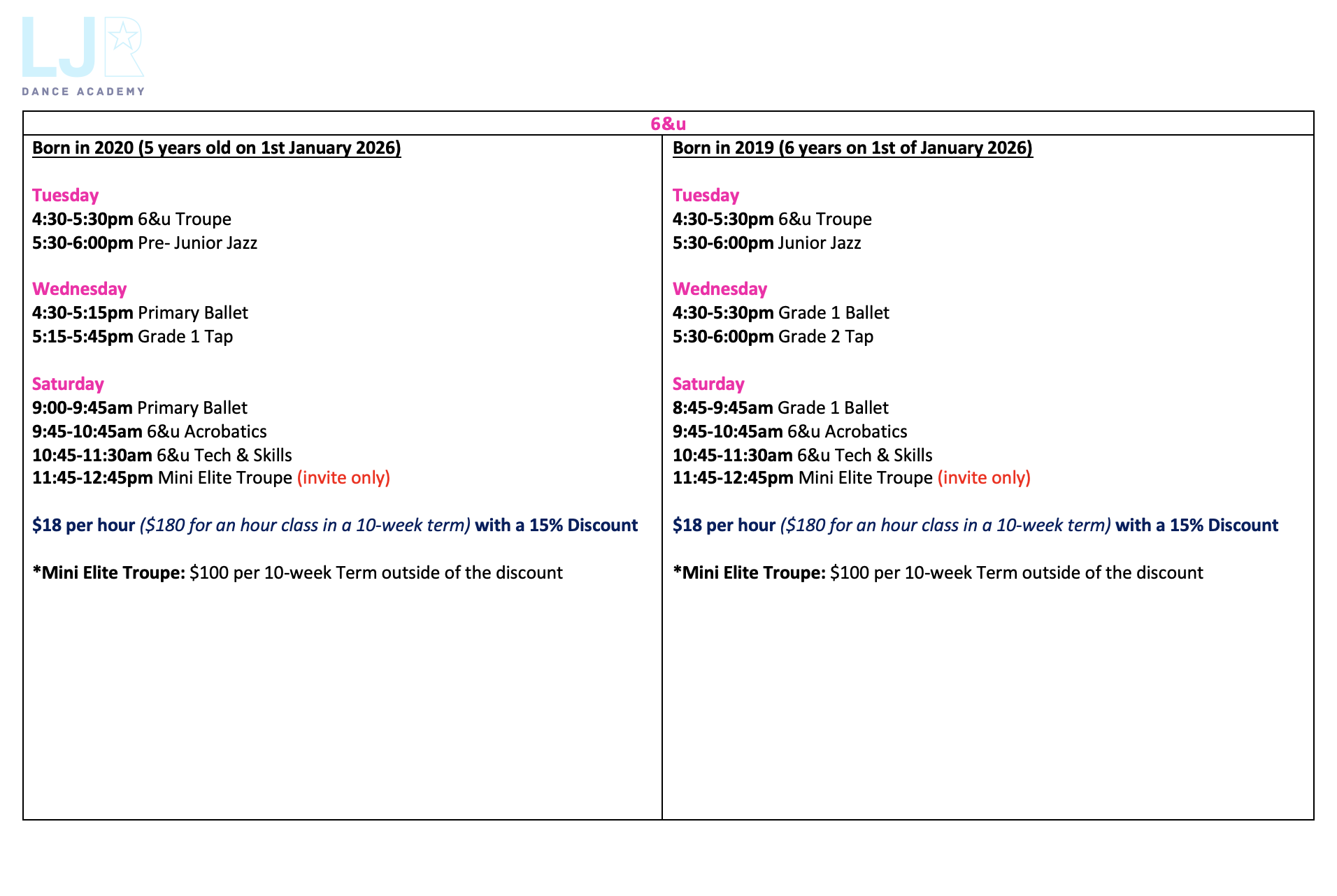
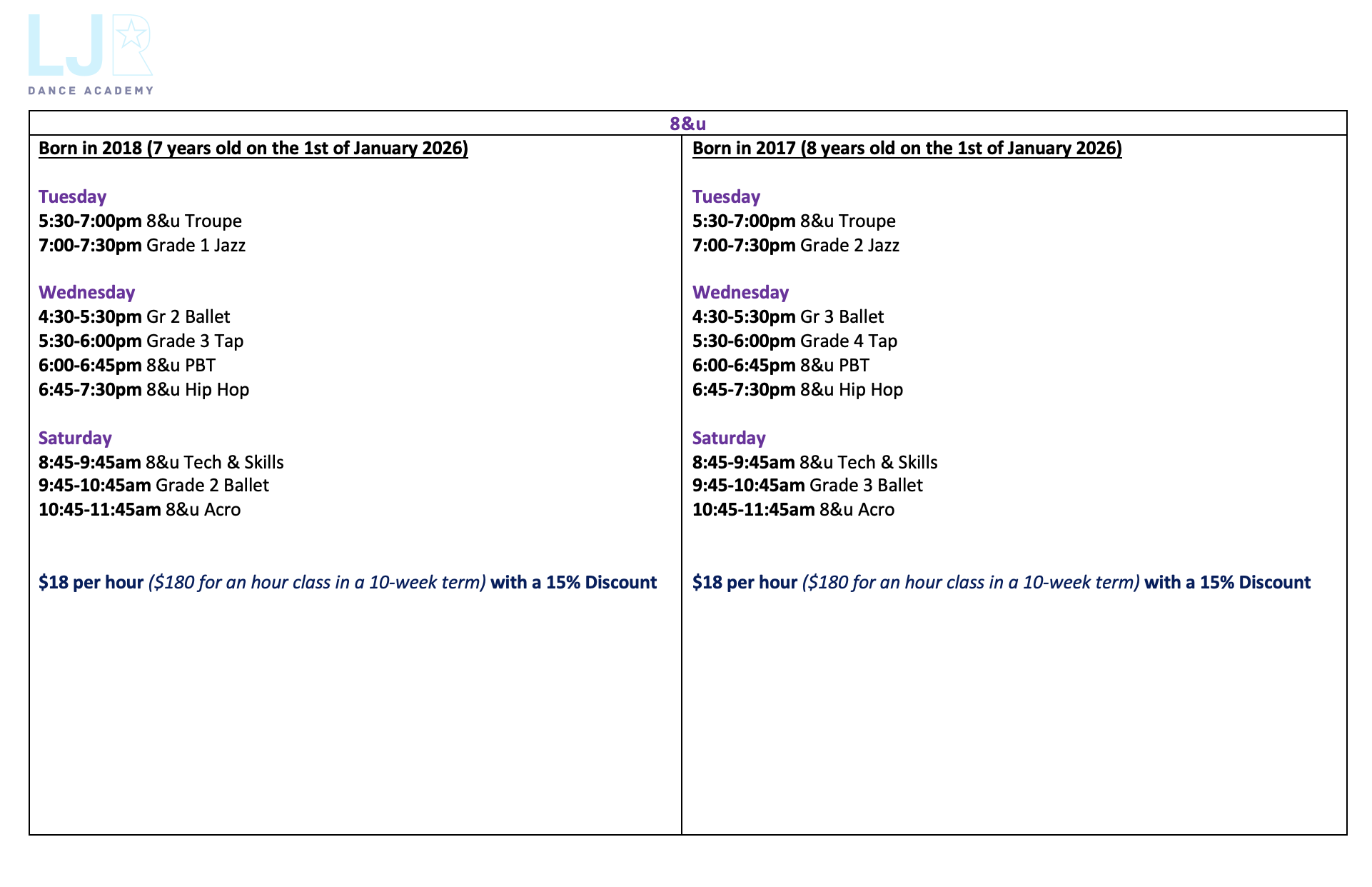
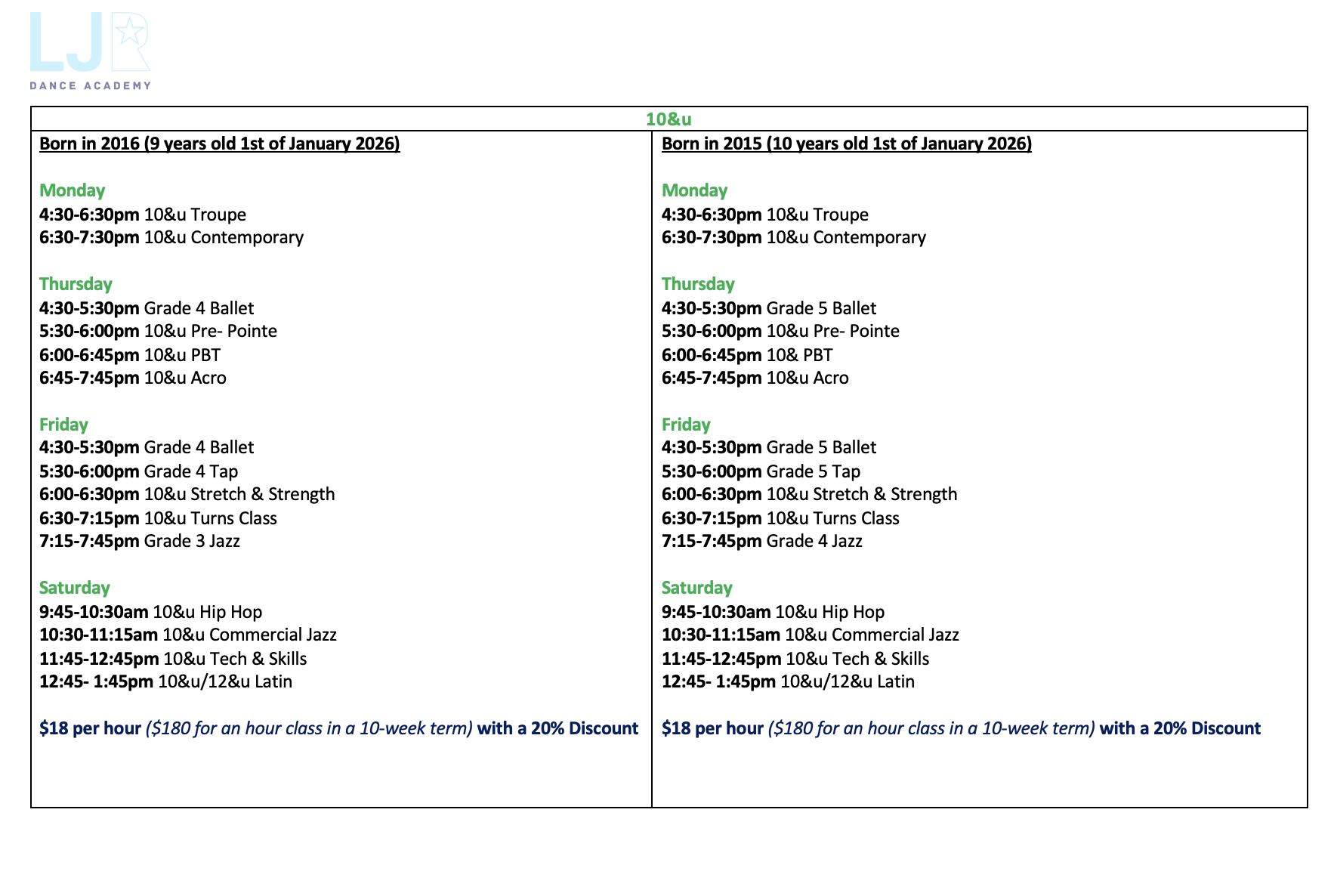
Please see below for The LJR Curriculum for your dancers age group.
Born in 2017 (8 years old on the 1st of January 2026)
Born in 2015 (10 years old 1st of January 2026)
Born in 2014 (11 years old 1st of January 2026)
Born in 2013 (12 years old 1st of January 2026)
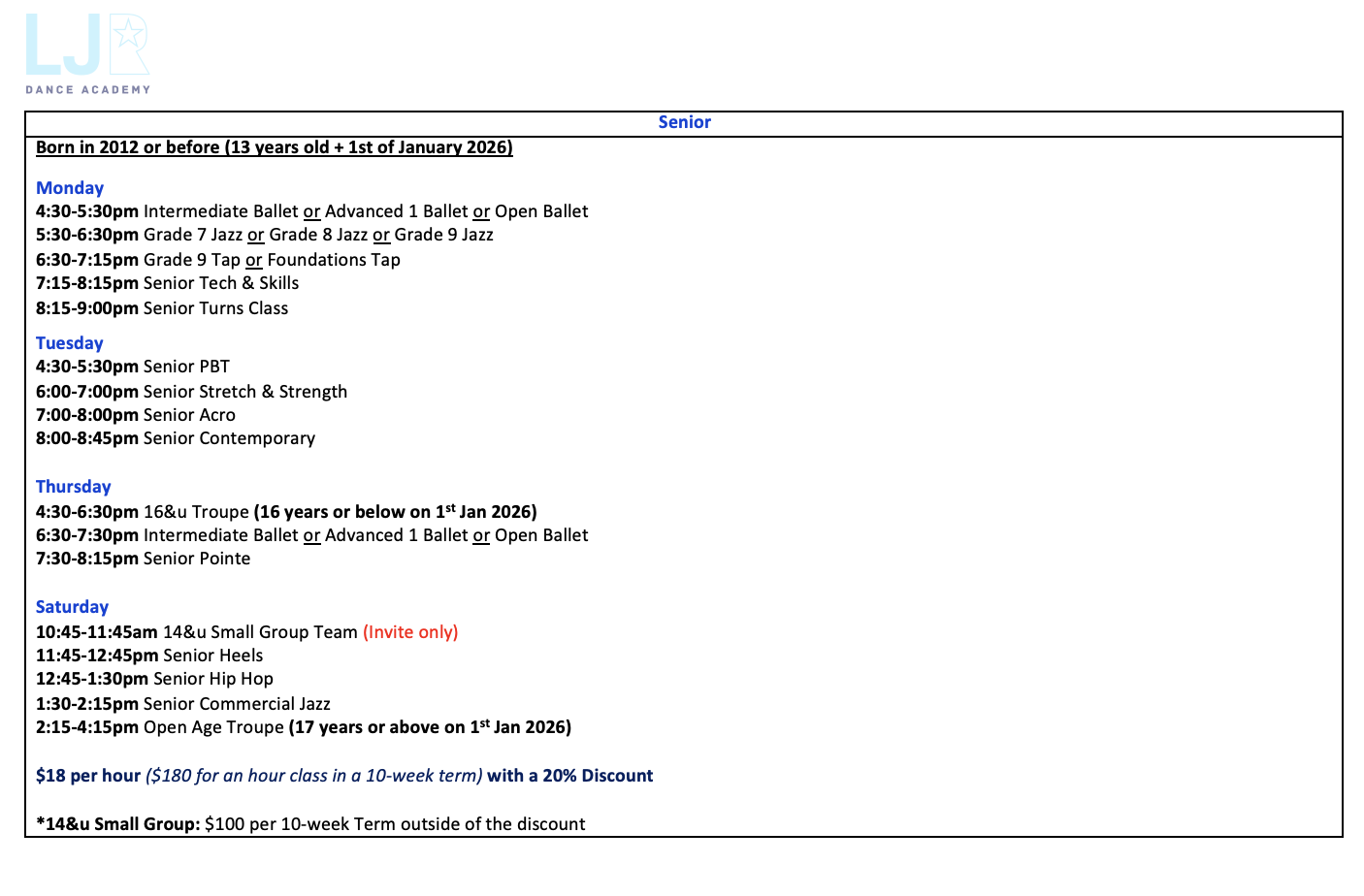
Born in 2012 or Before (13 years old+ 1st of January 2026)
Private Lessons: $80 per hour ($800 for an hour class in a 10-week term)
Small Group Acro: $50 per hour ($500 for an hour class in a 10-week term)
Ballet :
Classical ballet is the foundation of dance, based on formal movements and positions designed to allow for the highest class of agility, grace, speed, and control. At LJR Dance Academy, students study the Borovansky Method of Classical ballet, and have the opportunity to sit exams. We choose to offer this syllabus as it contains a high level of technical precision and structured training, whilst also engaging and encouraging each student’s dance quality, artistry, and performance. The Borovansky Syllabus is a combination of European and Russian methods which takes students through the official grading schemes of technical and artistic movements. In the younger grades, students are taught the basics of Classical ballet and how to successfully execute movements using correct muscles and technique. Once LJR has decided that a student is ready to progress to the next grade, they will have the opportunity to complete an examination. This examination will certify that the student displays the technical and stylistic attributes to further their training. Students typically complete annual examinations to receive their accreditation, which is particularly important to accomplish if they are dedicated to pursuing a career in dance. Students are also taught theory, which progresses throughout the grade levels and will be assessed during the exams. More information regarding exams can be found in our Examination Handbook.

Pointe:
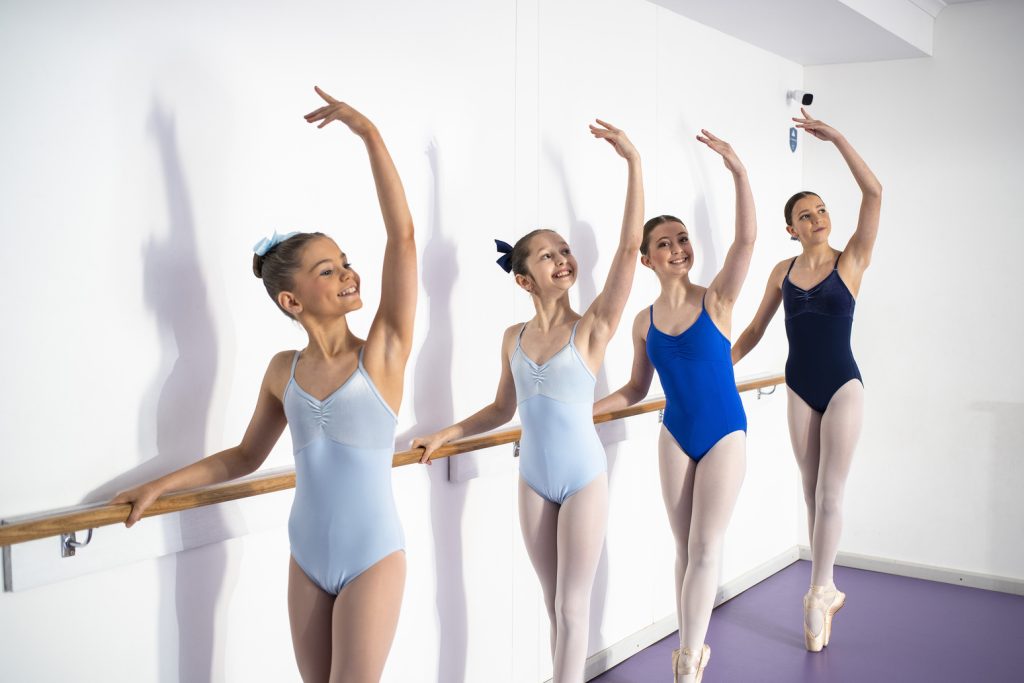
Pointe work is the process by which a dancer performs Classical techniques by supporting their body weight within their pointe shoes. Each student must be assessed before they can dance en pointe, as pointe work requires strong ballet technique and strength within the student’s feet and other muscles. Students will be able to learn the basics of pointe work, such as stepping up to pointe, how to hold the foot correctly in the shoe and the correct technique to execute a variety of steps. As students technically progress in their pointe work and further their knowledge and strength, they will advance into learning new steps that require a stronger pointe work technique.
Jazz :
The genre of Jazz has evolved over time, currently encompassing the elements of isolations, grounded movement, syncopation, and contractions to upbeat music. At LJR Dance Academy, students learn the Comdance Modern Jazz Syllabus and are given the opportunity to sit examinations. We choose to offer this syllabus as it enhances coordination, flexibility, stamina as well as giving students performance-based skills. Young students begin to learn the basics of jazz technique such as skipping, marching, isolating and dance combinations. They then progress through the grades, improving their jazz technique and increasing their repertoire of steps. Each grade begins with alternating warm up exercises and a floor stretch to ensure safe dance practices. Students are then asked to complete a series of corner work exercises, such as kick combinations, turning combinations, and jumping combinations. Following this, students are asked to perform a short dance routine with steps they have learnt in their grade. When progressing through the grades, students are taught different routines to develop their jazz technique and stylistic abilities. This syllabus also includes Lyrical and Contemporary in the advanced grades. Students are taught theory in the advance grades, which progresses throughout the grade levels and will be assessed during the exams. More information regarding exams can be found in our Examination Handbook.


Tap :
Tap is a genre of dance where metal taps are attached to the heel and ball of a soft shoe as a form of percussion. At LJR Dance Academy, younger students learn the LJR Tap Syllabus older students learn the Glen Wood Tap Syllabus. They also have the opportunity to sit examinations. We choose to offer these syllabi as the progression throughout the grades enables students to correctly execute challenging steps and syncopations, while also developing musicality and rhythmic skills. Our younger Tap students are guided through a technical introduction to the genre of Tap. They learn the basic elements of Tap such as ankle movements, and how to use their knee and hip joints correctly. Students then learn basic movements such as a shuffle, toe hits, stamps and more. Throughout the higher levels students extend their knowledge of Tap steps and execute complex amalgamations and performance routines. In these grades, students are required to learn the theory relevant to their grade. Theory assists the students to understand the technique of each step and how it can be counted in different routines. More information regarding exams can be found in our Examination Handbook.
Troupe :
Troupe lessons are for the purpose of learning group routines to compete with at competitions and perform at the concert. We aim to help students build technique whilst learning and practicing the choreography given to them. All students enrolled in Troupe will have the opportunity to perform on stage with the whole group at concert events. Troupes are important for dancers to participate in to foster a sense of teamwork in order to achieve a goal. Dancing on stage with your team is a feeling like no other and is extremely special to share with your dance friends. More Information about Troupe can be found in our Troupe Handbook.

Tech & Skills :
Tech & Skills class focuses on general technique and learning new skills. The class has a large focus on stretching and strength work to ensure our dancers can safely attempt skills. Different kicks, turns and jumps are taught in this class depending on the age group and ability level. Technique combinations are the focus in these classes.
PBT :
Progressing Ballet Technique (PBT) is a body-conditioning and strengthening program that enhances students’ dance technique and progression. PBT focusses on training the muscle memory required for multiple dance exercises. This program additionally assists with injury prevention and rehabilitation, which further enhances the ability of the dancer. It is sometimes challenging for students to feel and understand which muscles they need to engage to achieve the correct alignment and technique. However, PBT uses exercise balls, TheraBand’s and much more to assist the students in understanding a good sense of posture, weight-placement and feel of each muscle group activating. At LJR Dance Academy, we teach PBT because the focus on core strength, weight placement, alignment of the body and repetition of exercises assists our students in becoming strong and technically precise dancers.


Acrobatics :
The genre of acrobatics was formed from the basis of gymnastics, rhythmic gymnastics and circus contortion. Acrobatic movements, commonly known as ‘tricks’ require good balance, strength and agility. At LJR Dance Academy, students begin to learn basic acrobatic techniques and tricks to foster strength, and progress into more challenging movements. Students are then able to learn tricks such as walkovers, ariels, back and front handsprings, front aerials and much more. Our acrobatics program is based on safe and effective progression where students learn strength and stretch, balancing, limbering, tumbling and contortion exercises.
Stretch & Strength :
In the Stretch & Strength class students are taken through a deep stretch to improve flexibility of the whole body. Different flexibility exercises are taught along with many safe dance practice tools to ensure our dancers are stretching safely and effectively. Students learn a range of strengthening exercises and improve the overall strength of their body. Students are taught about the importance of having sufficient strength to complete complex technical skill.

Contemporary/Lyrical :
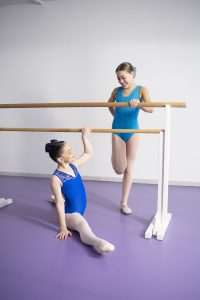
The genre of Contemporary is a style of expressive dance containing modern movements derived from Ballet and Jazz. Like Contemporary, Lyrical is a genre of dance that highlights personal expression and meaningful lyrics. Contemporary and Lyrical connect the mind to the body, as the fluid movements convey emotions and stories of the individual. These genres are versatile and unstructured, allowing for the exploration of the movement, and creating a sense of improvisation, unlike ballet. These genres also focus on floor work, using gravity as an objective for contractions and releases. Our Contemporary classes at LJR Dance Academy promote creativity in the dancer, as they learn to interpret lyrics and express messages through movement. This encourages self-expression and allows for our students to share their thoughts and emotions, creating a sense of empowerment. Students will learn different Contemporary and Lyrical exercises and combinations to correctly endorse proper technique and movements in these genres.
Turns Class :
Students learn about correct posture and are taught specific exercises to develop the alignment, core strength and control required to successfully execute multiple turns. The class focuses on spotting technique, balance, and body awareness to improve stability and consistency. Students learn a variety of turning skills including different fouetté variations, kick turns, pirouette preparations and finishes, as well as challenging turning combinations designed to build confidence, endurance and technical precision.

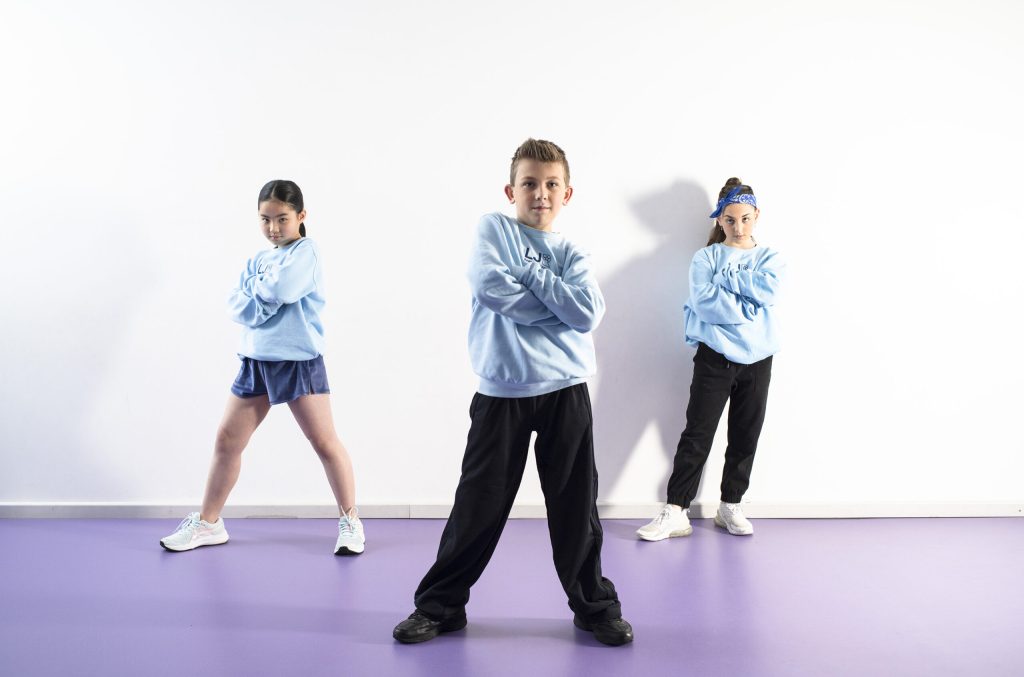
Hip Hop :
Hip-Hop dance is known as a street style, with movements derived from mambo, samba, jazz and martial arts. At LJR Dance Academy, students learn styles such as house, locking, waacking, and breaking, which all have their own techniques and vocabulary. Students also learn correct Hip-Hop techniques such as waving and popping to enhance their performance quality and add an extra flavour/individuality to their movements. Students learn a series of groove exercises, implementing moves from different eras and origins. They learn old school grooves new school grooves with different dance routine/combination each lesson to improve their ability to pick up choreography and confidently perform it within the lesson. This is a major skill that fosters professionalism in a dancer. Students are also guided through skills set to assist with freestyling as this is a major part of the Hip Hop dance culture.
Commercial Jazz :
Commercial Jazz is a modern dance style, taking elements of Jazz, Hip Hop, and urban dance to create an energetic and eye- catching genre. Commercial Jazz is commonly seen at live performances, in music videos, in films and commercials. At LJR Dance Academy we believe that Commercial Jazz is an extremely important genre for pre-professionals to train in, as many jobs in the industry require a strong Commercial Jazz technique. A student who trains in Commercial Jazz can have professional careers as a backup dancer for a singer, television work and much more. In our Commercial Jazz class, students learn different exercises to endorse proper Commercial Jazz technique and posture. Students also learn how to dance on camera and how to perform as a live backup dancer, with exercises to support these skill sets.


Latin :
In our Latin dance classes, students are introduced to the vibrant world of Latin rhythms while also learning the fundamentals of ballroom dancing. Through this dynamic curriculum, they explore various styles, including the passionate Tango, the graceful Waltz, the lively Foxtrot, and the energetic Quickstep. At LJR, we emphasise the elegance and artistry of each dance, helping students develop not only their technical skills but also their expressiveness on stage. This comprehensive approach fosters well-rounded dancers who are confident and capable of captivating an audience. Students engage in a variety of exercises and routines that challenge their coordination, timing, and creativity. As they progress, they learn to embody the unique characteristics of each dance style, enhancing their performance quality and stage presence. The combination of Latin and ballroom dance not only builds a strong technical foundation but also encourages teamwork and camaraderie among classmates. Overall, our Latin dance classes cultivate a passion for dance while equipping students with the skills needed to shine on stage.